

What this guide helps you decide
A practical Ringlock scaffolding method statement framework covering site preparation, erection sequence, ties, platforms, inspection and dismantling.
Article contents⌄
- 011. Define the scope
- 022. Prepare materials and work area
- 033. Check the supporting surface
- 044. Establish the first lift accurately
- 055. Build progressively with stability maintained
- 066. Platforms, access and edge protection
- 077. Interfaces and special conditions
- 088. Inspection and handover
- 099. Modification control
- 1010. Dismantling
Ringlock scaffolding can be erected quickly and repeatedly, but a safe result still depends on planning, foundations, geometry, bracing, ties, access, platforms and inspection. This guide adapts Thien Phu’s Vietnamese Ringlock method article into an English project framework.
011. Define the scope
Confirm what the scaffold is supporting: façade work, maintenance, MEP, structural access, temporary enclosure or another activity. Working height, plan dimensions, platform levels, access points and loading should be defined before erection.
022. Prepare materials and work area
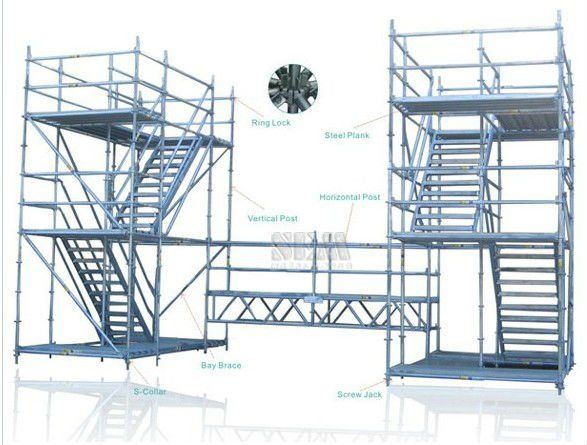
Inspect standards, ledgers, diagonal braces, base collars, jacks, platforms, ladders, ties and project accessories. The erection zone should be controlled so that workers are not exposed to traffic, falling objects or conflicting activities.
033. Check the supporting surface
The base must provide adequate support and allow the scaffold to be levelled. Weak, irregular or uncertain support conditions require project-specific treatment before vertical standards are erected.
044. Establish the first lift accurately
Set out the base jacks and base collars, connect the first ledgers and check bay dimensions, level and square. Errors at the first lift accumulate as the scaffold rises.
055. Build progressively with stability maintained
Install standards, ledgers and diagonal braces in the planned sequence. Do not build a large unstable height and plan to brace it later. Ties or other stabilization measures should be installed as required by the approved arrangement.
066. Platforms, access and edge protection
Install working platforms at the required levels and provide suitable access. Guardrails, intermediate protection and toe boards or other falling-object controls should be included where required.
077. Interfaces and special conditions
Façades, cantilevers, transfer beams, suspended areas, openings and obstructions can change the scaffold load path. These conditions require specific review rather than field improvisation.
088. Inspection and handover
Before use, inspect foundations, verticality, connections, bracing, ties, platforms, access, edge protection and overall condition. Record the status in the form required by the project.
099. Modification control
Users should not remove braces, ties, ledgers or platforms to gain access without authorization. A small change can reduce stability or overload another part of the scaffold.
1010. Dismantling
Dismantle in a controlled reverse sequence while maintaining stability. Components should be lowered safely, segregated if damaged and reconciled before return or storage.
For representative components, see Ringlock Scaffolding. For site service support, see Scaffolding Erection Services.
Need help applying this to a real project?
Send your working height, load requirement, drawing, BOQ or site photos. Our team can help narrow the appropriate scaffolding or equipment approach.

Thien Phu Technical Editorial Team
Prepared from Thien Phu's field, product and project-support experience in Vietnam, then reviewed for terminology, standards context and practical use by the Thien Phu Technical Desk. Read our technical editorial policy →


