What this guide helps you decide
A practical guide to scaffolding risks when working at height and the controls used for access, fall protection, stability, inspection and safe use.
Article contents⌄
- 01Working at height with scaffolding: main risks and controls
- 02Platform and edge-protection controls
- 03Stability and structural integrity
- 04Access between levels
- 05Load control and housekeeping
- 06Inspection by a competent person
- 07When should the scaffold be reviewed again?
- 08Working-at-height planning checklist
- 09Working at height with scaffolding FAQ
- —What are the main risks when working at height on scaffolding?
- —How often should scaffolding be inspected?
- —Can workers remove guardrails, ties or braces to make access easier?
Working at height with scaffolding introduces several hazard groups at the same time: falls, scaffold instability, falling objects, electrical contact, unsafe access and changes to the scaffold after handover. Safe scaffolding work at height therefore depends on more than guardrails alone; it requires a suitable scaffold, controlled use, competent inspection and clear status control.

01Working at height with scaffolding: main risks and controls
| Risk | Typical control focus |
|---|---|
| Fall from platform | Complete platform, edge protection, safe access and task-specific fall protection where required |
| Scaffold collapse or movement | Foundation, geometry, bracing, ties, anchors, load control and inspection |
| Falling tools or materials | Toe boards, screens/netting where required, housekeeping and exclusion zones |
| Unsafe access | Proper ladders, stairs, gates and unobstructed routes |
| Electrical contact | Safe clearance and site controls around energized equipment and overhead lines |
| Unauthorized alteration | Status control, supervision and re-inspection after changes |
02Platform and edge-protection controls

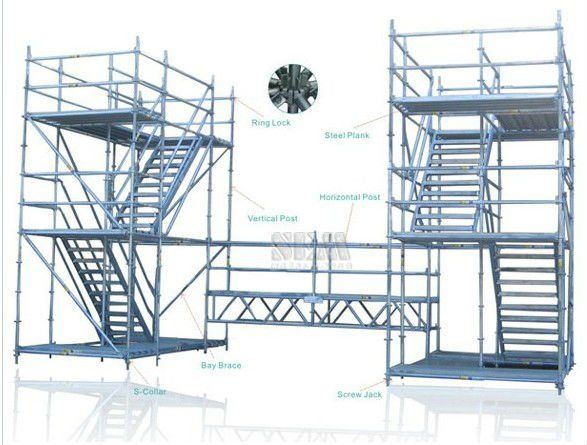
Working platforms should be suitable for the intended activity, correctly supported and free from unsafe gaps or movement. Guardrails, intermediate protection and toe boards are installed where required by the applicable rules and project arrangement. Open access points and ladder openings may need gates or other controls.
03Stability and structural integrity
Falls are not the only concern. A scaffold can become unsafe if its support settles, braces or ties are removed, components are damaged, loading changes or weather affects stability. Users should not alter a scaffold simply to create more room for materials or access.
For a structured check, use the 36-point Scaffolding Inspection Checklist.
04Access between levels
Workers should use the access method intended for the scaffold—such as an internal ladder, access ladder or stair tower—rather than climbing braces or frames unless the specific system and rules permit that access method. Tools and materials should be moved in a way that allows workers to maintain safe access.
05Load control and housekeeping
Scaffolds and platforms should not be loaded beyond their permitted condition. Materials should be distributed so they do not create concentrated overloads or obstruct access. Debris, cables and loose tools can create trip and falling-object hazards even when the scaffold itself is correctly erected.
06Inspection by a competent person
Inspection requirements depend on jurisdiction. Under OSHA 1926.451 in the United States, scaffolds and scaffold components must be inspected for visible defects by a competent person before each work shift and after an occurrence that could affect structural integrity. OSHA also defines a competent person as someone capable of identifying existing and predictable hazards and authorized to take prompt corrective measures.
Official references: OSHA 1926.451 and OSHA 1926.450 definitions.
07When should the scaffold be reviewed again?
- after alteration, extension or partial dismantling;
- after impact, settlement or another event that may affect stability;
- after severe weather where the project rules require review;
- when a tie, brace, platform or safety component is removed or damaged;
- when the intended work or loading changes.
08Working-at-height planning checklist
- Confirm the scaffold is suitable for the task and released for use.
- Check the access route and working platform before starting.
- Keep within the permitted loading and working arrangement.
- Do not remove ties, braces, guardrails or decks without authorization.
- Report damage, movement, settlement or missing components immediately.
- Stop use when status is uncertain or corrective action is required.
09Working at height with scaffolding FAQ
What are the main risks when working at height on scaffolding?
The main risk groups include falls from platforms, scaffold movement or collapse, falling objects, unsafe access, electrical contact and unauthorized changes to the scaffold after handover.
How often should scaffolding be inspected?
The required frequency depends on the governing jurisdiction and project rules. As one example, OSHA requires inspection by a competent person before each work shift and after events that could affect structural integrity.
Can workers remove guardrails, ties or braces to make access easier?
Scaffold components that affect stability or fall protection should not be removed informally. Any change should follow the project control process and trigger review where required.
Safety note: This page is general project guidance. It does not replace local working-at-height law, scaffold-specific training, manufacturer instructions, an engineered design or a competent-person site assessment.
For standards context, see Scaffolding Standards & Technical Guides. For project support in Vietnam, contact Thien Phu Technical Support.
Need help applying this to a real project?
Send your working height, load requirement, drawing, BOQ or site photos. Our team can help narrow the appropriate scaffolding or equipment approach.

Thien Phu Technical Editorial Team
Prepared from Thien Phu's field, product and project-support experience in Vietnam, then reviewed for terminology, standards context and practical use by the Thien Phu Technical Desk. Read our technical editorial policy →